
Large-container water bottling
Water Filling Equipment for 3–15 L Large Bottles
A 5 L bottle and a 10 L container can need different handling even when both hold drinking water. Allot Tech coordinates equipment sourcing in China around actual bottles, closures, factory space and finished-output requirements. Confirm the proposed machine and services in the project quotation.
Direct answer
Start with the bottle drawing and samples, not capacity alone. The catalog lists a 3–15 L rotary washing-filling-capping configuration and a 3–10 L linear configuration. These are reference ranges, not proof that one machine accepts every size, shape or handle. Approve each format and its output separately.
Large-container water bottling
Resolve four production problems before selecting a machine
Use the same bottle samples, product conditions and counting boundary when comparing proposals. Ask each supplier to identify the required change parts and excluded equipment.
| Production problem | What to specify | Evidence before acceptance |
|---|---|---|
| A larger or handled bottle jams at transfer | Provide height, body width, neck finish, handle envelope, base shape and empty/filled samples. Check support, guides, starwheels or grippers for the proposed system. | Run every intended bottle-and-cap combination through infeed, rinsing, filling, capping and discharge. Record instability, contact damage, jams and rejects; approval of a round 5 L bottle does not approve a rectangular 10 L bottle. |
| Rotary and linear offers are difficult to compare | Compare station arrangement, bottle support, filling principle, closure tooling, cleaning access and usable floor space. Do not assume one layout is always faster or cheaper. | Request a format-by-format compatibility list and a dimensioned layout with maintenance clearance. State trial conditions and contractual output; the catalog provides no verified bottles/hour for these two configurations. |
| Frequent 5 L / 10 L changeovers reduce daily output | List format parts, guide adjustment, recipes, filling settings, cap changes and cleaning tasks. Include restart rejects and operator time. | Time the complete changeover until stable acceptable bottles emerge, not just the mechanical adjustment. Record good bottles at the agreed line exit over a representative run. |
| Filled containers accumulate or are difficult to move | Check conveyor transfers, accumulation, handle orientation, packing and the handoff to pallets or racks. Include the weight of the filled container and packaging. | Review the layout with the responsible safety team and specify suitable handling assistance. Test downstream flow using filled samples; do not treat filler discharge as proof that packing can sustain the same rate. |
Send a quotation-ready format brief
Freeze the bottle list and supply boundary before comparing prices. Mark unconfirmed items and ask for written acceptance criteria instead of inferring compatibility from a machine photograph.
- Send drawings and samples for every bottle, cap and handle, plus product type and required fill volume.
- State accepted bottles/hour for each format, production hours, changeover frequency, utilities, site dimensions and packing method.
- Separate machine, change parts, conveyors, treatment, packing, installation and training; assign the owner of each interface and acceptance test.
Equipment scope
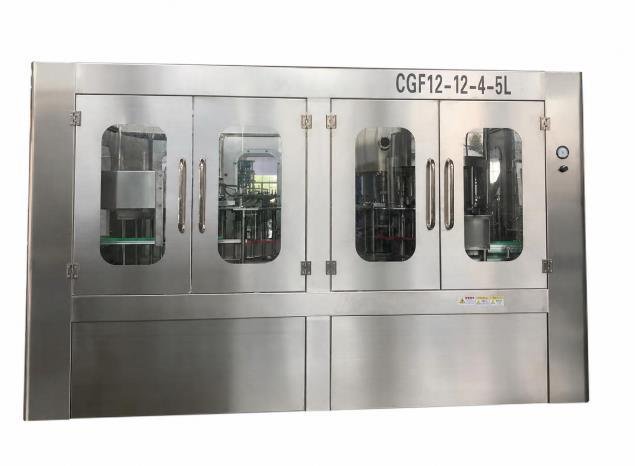
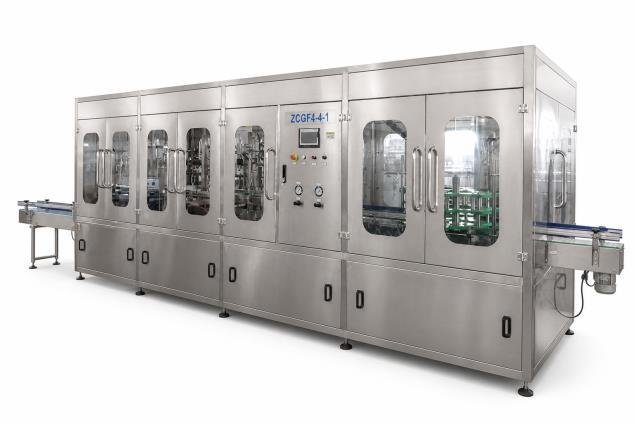
Source: Allot Tech Beverage Bottling Catalog 2026, page 20. Original catalog images show representative configurations, not proof of every format's compatibility. Rotary and linear output, current availability and final supply scope require project-specific confirmation.
Large-bottle filling machine questions
Can the same machine fill 5 L, 10 L and 15 L bottles?
Only when those actual formats are confirmed in its configuration. The catalog's rotary range is 3–15 L; its linear range is 3–10 L, so 15 L is outside the printed linear range. Nominal volume alone does not confirm geometry, cap fit, tooling or output.
Does the catalog's 3,600 bottles/hour figure apply here?
No. Page 20 assigns up to 3,600 bottles/hour and ±1% precision to a separate piston filler with a printed 200–1,000 ml volume range. Do not transfer those values to the large-container rotary or linear machines. Obtain their project-specific performance basis.
How much product water does 600 bottles/hour at 10 L require?
Filling alone requires 600 × 10 = 6,000 L/h. This is an illustrative demand calculation, not a machine rating. Add the engineered rinsing, cleaning and loss allowances, and distinguish product-water demand from raw-water feed and treatment capacity.
Are large PET bottles the same project as returnable 5 gallon bottles?
No. Returnable 18.9 L bottles introduce inspection, return-condition and validated washing requirements. Define new versus reusable containers explicitly. Neither project automatically includes treatment, conveyors, packing or installation unless those items appear in the agreed supply list.
Related buyer guides
Next step